● Your local Berkeley & East Bay roofing team Open Mon–Sat, 8am–6pm · Get a Written Estimate
Non-Renewal · FAIR Plan · Documentation

Roof Insurance Claim in Berkeley

Roof insurance claim Berkeley work has changed its meaning. The claim that matters in this city now starts with a non-renewal letter, not a storm: an insurer reads your roof from photographs, decides your hillside home is a wildfire risk, and gives you 75 days to find another policy. We build the answer — a dated documentation pack and a workplan run against that clock — for the homeowner, and formatted for the broker who has to send it.

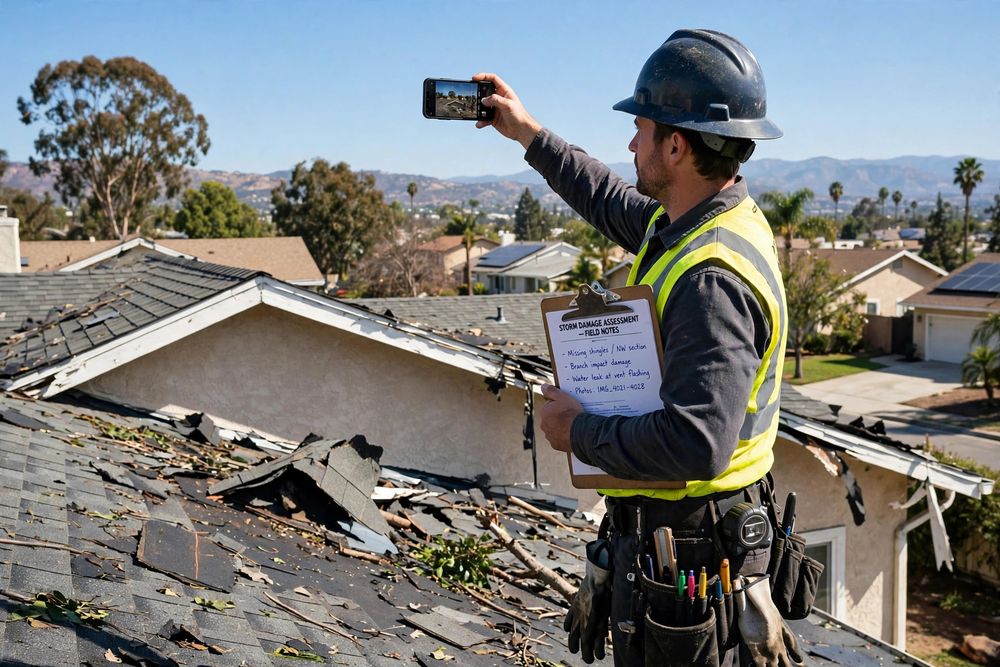
A roofer on a storm-damaged roof photographing it with a phone, clipboard under his arm
75 daysCalifornia’s window to replace a non-renewed policy12 measuresThe state mitigation list insurers must creditBroker-readyA pack formatted for your agent to send
The Flagship Service

What is the 75-day workplan?

California law gives a non-renewed homeowner 75 days to find a replacement policy — the figure Amy Bach of United Policyholders, the consumer advocacy group, gives Berkeley homeowners in Berkeleyside’s insurance reporting, alongside her advice: do not procrastinate, and ask the insurer the practical question — what would change your mind? That question is a documentation question. Our roof insurance claim Berkeley service is built to answer it before the clock runs out.

Week one is the inspection: a documented inspection of the whole roof — condition, materials, Class A status — photographed and dated. Then the pack is assembled: the photo set; material and assembly evidence; permit records; and a mitigation checklist mapped line by line to the twelve Safer-from-Wildfires measures in the state rule (10 CCR §2644.9), the measures a wildfire-rating insurer must recognise. The same rule gives you the right to see your property’s risk score, learn how to lower it, and appeal it — the pack is written as the evidence for exactly those conversations.

If the roof itself is the problem, the work is sequenced against the deadline: the replacement itself permitted and scheduled with the rainy-season constraint stated out loud, not hidden — the market evidence is blunt that non-renewal deadlines collide with winter and with busy roofers, and a plan that admits it beats a promise that ignores it. What we will never do is guarantee an insurer’s decision. What we hand you is the strongest honest file: the roof, documented the way underwriters actually read roofs.

The forward fact, from the City’s own memo

From January 1, 2028, SB 1076 bars insurers from refusing properties that meet state mitigation standards — the position the City of Berkeley’s Disaster and Fire Safety Commission backed in its April 2026 memo on the hillside insurance crisis. Documented hardening is becoming the currency of insurability in the hills. A roof file is how a homeowner holds that currency.
How Underwriting Sees You

What do insurers actually look at?

A photograph. Bach again, in the same Berkeleyside reporting, on how the reading has changed: insurers “used to insure people’s properties warts and all — pine needles on the roof and leaves in the gutter. Now all they see are the warts.” The roof is the largest, most photographable surface of your house, and the gutters in that photograph are part of the evidence whether you staged them or not. Our packs are built to that reality: clean, dated, specific — condition and materials proven, not asserted.

For many hills households the destination is a two-policy structure, and the pack has to serve both halves. The California FAIR Plan — the insurer of last resort, with a residential limit of $3 million — commonly gets wrapped by a Difference-in-Conditions policy that fills the gaps the FAIR Plan leaves. Each side asks for roof evidence, in slightly different dialects. We write the pack once, formatted for your broker to send to either — because in this market the broker is a reader too, and nobody in the local roofing trade writes for them. We do.

The cost pressure runs underneath everything: the FAIR Plan’s approved average rate increase of 29.1 percent took effect October 15, 2026, landing on the same households being told to fund mitigation. That is the arithmetic that makes a documentation pack a financial instrument and not a courtesy — the difference between the standard market and the last-resort market, priced per year, against the one-time cost of proving your roof.

The Market, By ZIP

Where did Berkeley’s insurance market go?

A roof insurance claim Berkeley file reads differently in 94707 than in 94710, because the crisis is not evenly spread. FAIR Plan policy counts by Berkeley ZIP, fiscal 2021 to fiscal 2025 — raw counts, not market share, as the analysis itself cautions:

ZIP — neighbourhoodsFY2021FY2025
94707 — Thousand Oaks, Westbrae18376
94705 — Claremont, Elmwood69451
94708 — Cragmont, La Loma, the hills106691
94709 — Northside, Gourmet Ghetto1486
94710 — West Berkeley flats2541

Source: California FAIR Plan policy data by ZIP, fiscal years ending September 30, analysed by Berkeley realtor Megan Micco. Growth over the period: 94707 up 1,989 percent, 94705 up 554 percent, 94708 up 552 percent — against 64 percent in the West Berkeley flats.

94707 — Thousand Oaks, Westbrae+1,989%94705 — Claremont, Elmwood+554%94708 — Cragmont, La Loma, hills+552%94709 — Northside, Gourmet Ghetto+514%94710 — West Berkeley flats+64%
Growth in FAIR Plan policies by Berkeley ZIP, FY2021–FY2025 (raw policy counts, not market share). Source: FAIR Plan ZIP data via Megan Micco’s analysis. The hills added hundreds of last-resort policies; the flats barely moved.
Pain Points

What does the letter actually do to a household?

Most roof insurance claim Berkeley calls begin in the week the letter arrives, and the letter is doing several things at once. Berkeleyside’s reporting describes what non-renewed Berkeley residents find on the open market: extraordinary prices, and at best, sub-par protection. Bach’s summary is the one homeowners repeat back to us: if you live anywhere near brush, you have probably gotten one already — or are dreading the day you get one. Dread, it turns out, is a poor project manager. The 75 days start whether the roof file exists or not.

Underneath the dread sits a specific, answerable fear: the roof. It is the surface the underwriter photographed, the line item the risk score weighs first — a Class A fire-rated roof is literally the first structure measure on the state’s twelve-measure mitigation list — and the one part of the house a homeowner can change inside a single season. Gutters full of needles, an undocumented assembly, a shake roof in Zone 2: each is a sentence in the insurer’s letter, and each has a documented answer.

The households that come out of this well are not the ones who argued loudest. They are the ones who treated the letter as a project with a deadline: inspection in week one, evidence assembled while there was time, work sequenced against the calendar, broker handed a file instead of a phone call. That is the entire design of this service — and it is why the pack is formatted for the broker’s desk, not just your kitchen table.

Who We Serve

Who is this service for?

Non-renewed hills homeowners

You have a letter and a 75-day clock. We run the workplan against it: inspection in week one, the mitigation checklist mapped to the state’s twelve measures, and the pack filed before the deadline — with the rainy-season constraint managed in the open.

FAIR Plan policyholders

Your renewal evidence requests land on a roof nobody has documented. We build the file the FAIR Plan and your DIC carrier each ask for — condition, materials, Class A status — from one inspection and one photo set.

Sellers and buyers in the hills

Insurability now transfers — or fails to — at sale. A documented roof file in the disclosure packet answers the buyer’s first insurance question before their broker has to ask it, on streets where that question kills deals.

Brokers and agents

You are a reader of this service too. Our packs arrive formatted for forwarding: dated photographs, assembly evidence, permit records, the mitigation checklist — the roof section of your client’s file, written by the people who climbed it.

Questions, Answered

Insurance Documentation Questions Berkeley Homeowners Ask Us

01 I just got a non-renewal letter. How long do I have?

Seventy-five days to find a replacement policy — the window Amy Bach of United Policyholders gives in Berkeleyside’s insurance reporting, with the advice attached: do not procrastinate. Spend week one on a documented roof inspection, not on phone calls. The clock is also why our workplan is dated: inspection first, evidence assembled next, any roof work sequenced against the deadline, and the pack in your broker’s hands with time to spare.

02 What exactly is in the documentation pack?

Dated roof-condition photographs; material and Class A assembly evidence; permit records; and a mitigation checklist mapped line by line to the twelve Safer-from-Wildfires measures (10 CCR §2644.9) that a wildfire-rating insurer must recognise. It is formatted for your broker or agent to forward — to a standard-market carrier, to the FAIR Plan, or to a DIC carrier — without reformatting, because in a 75-day window nobody has time to rebuild a file.

03 Can a new roof get my policy back?

Sometimes the roof is the deciding evidence; we will never promise an insurer’s decision, because it is not ours to promise. What the rules do say: under 10 CCR §2644.9, insurers rating by wildfire risk must recognise mitigation measures — a Class A fire-rated roof is the first structure measure on the list — and must disclose your risk score, how to lower it, and an appeals process. And from January 1, 2028, SB 1076 bars insurers from refusing properties that meet state mitigation standards. Documentation is how you hold up your side of each of those rules.

04 What does the FAIR Plan ask for about my roof?

Evidence, in the same categories every hills file now turns on: the roof’s condition, its materials, and its fire rating — with Class A status the item that matters most in the Very High zone. Many Berkeley hills households pair the FAIR Plan (residential limit $3 million) with a Difference-in-Conditions wrap policy, and each carrier wants the roof documented in its own format. Our pack is written once and formatted to serve both, so your broker is not commissioning two inspections.

05 Do you deal with my broker or insurer directly?

We write for them; you and your broker send. The pack is addressed to the reader who decides — dated photographs, assembly evidence, permit records, the mitigation checklist — in a form a broker can forward the day it arrives. If an underwriter or adjuster wants the roof walked again or a specific photograph retaken, we do that too. What we do not do is negotiate coverage: that is your broker’s craft, and our job is to make sure they negotiate with evidence in hand.

Keep Reading

Related services in Berkeley

Ready When You Are

Holding a letter? The clock is already running.

Roof insurance claim Berkeley help starts with an inspection in week one and ends with a file your broker can send: photographs, Class A evidence, and the mitigation checklist, assembled inside your 75 days. Call us today — the deadline will not move, but your file can be ready before it arrives.

Get a Written Estimate